Pediatric Clinics, Children's Hospitals, and Youth Therapy: Redacting Minors (HIPAA + COPPA + State Law)

Mateusz Zimoch
Published: 6/9/2026

A pediatric image can identify a child through far more than a face, so anonymization here means altering the photo or video until nothing - in the picture itself or its visible context - still points to a real minor. In pediatric settings, this usually starts with face blurring, but it should also consider wristbands, wall charts, computer screens, name tags, distinctive tattoos, family members, visitors, vehicle license plates, and background details that may reveal a child’s identity.

This article is limited to photos and videos in the United States. It focuses on pediatric clinics, children’s hospitals, youth behavioral health practices, therapy providers, and similar organizations that record or publish visual material. It is not legal advice. It describes common compliance practice for teams that need a practical redaction workflow before sharing footage with families, insurers, counsel, public agencies, or marketing teams.

Where pediatric and youth care providers record minors?

Minor patients appear in more visual material than many organizations expect. The highest-risk recordings are rarely polished marketing assets. They are often operational, clinical, security, or incident-related videos created for a specific purpose and later reused for another.

Common examples include therapy session recordings used for supervision, parent coaching, treatment review, or quality assurance. In youth behavioral health, video may capture the patient’s face, voice, posture, distress, family dynamics, the therapist, and other minors in a group setting.

Children’s hospitals and pediatric clinics also create incident footage. This can include hallway security video, waiting room recordings, emergency department interactions, transport areas, entrances, parking lots, school-based clinic spaces, and child life activity areas. Even where a child’s diagnosis is not visible, the fact that the child appears inside a pediatric oncology unit, behavioral health wing, or specialty clinic may reveal sensitive context.

Telehealth adds another layer. Recordings may show the child, siblings, parents, home environment, school materials, medication containers, wall calendars, computer screens, and documents on a table. If a recording is later exported, sent to counsel, used in staff training, or clipped for a presentation, the visual privacy review should happen before sharing.

A black-and-white photo of a newborn's foot with a hospital ID band, set against a soft blanket.

How HIPAA, COPPA, and state law overlap for minors’ images?

Under HIPAA, a photo or video can be protected health information when it is created or held by a covered entity or business associate and relates to an individual’s health care, payment, or health status [1]. HIPAA’s de-identification framework expressly treats full-face photographic images and comparable images as identifiers under the Safe Harbor method [2]. For pediatric providers, this makes face blurring a baseline, not complete, control before using images outside the original care context, unless another compliant basis applies.

COPPA can also matter, but not in every pediatric care scenario. COPPA applies to covered operators of websites or online services directed to children under 13, and to covered operators with actual knowledge that they collect personal information from children under 13 [3]. The COPPA Rule defines personal information to include a photograph, video, or audio file containing a child’s image or voice [4]. A children’s hospital portal, therapy app, online intake experience, patient story campaign, or interactive education platform may therefore require a COPPA review if the service is a covered online service directed to children or has actual knowledge that it is collecting personal information from children under 13; otherwise, HIPAA and state law may be the primary analysis.

State law adds further complexity. States may regulate medical records, mental health records, minors’ consent, child abuse and neglect records, biometric identifiers, student health information, and confidentiality in therapy settings. Federal rules may also matter in specific contexts, including 42 CFR Part 2 for qualifying substance use disorder programs and records, and education privacy rules in some school-based settings. Some states impose stricter rules for behavioral health, substance use treatment, school-based services, or recordings of clinical encounters. The practical takeaway is simple: if the video shows a minor in a health care or therapy context, assume that a state-specific review may be needed before disclosure or publication.

Legal layer

Why it matters for photos and videos of minors

Common visual redaction response


HIPAA Privacy Rule

Images can be PHI when linked to care, payment, or health status. Full-face images are listed as identifiers in the Safe Harbor method.

Blur minor patients’ faces and visible identifiers before external use, unless a compliant authorization or other permitted basis applies.

COPPA

Covered online services directed to children under 13, or with actual knowledge of collecting from children under 13, must treat photos, videos, and audio containing a child’s image or voice as personal information.

Review child-facing websites, apps, portals, campaigns, and upload tools before collecting children’s images from children or enabling uploads or publication.

State confidentiality laws

State rules may be stricter for minors, therapy, behavioral health, school-based care, recordings, biometric data, or sensitive services.

Apply a state-specific approval step before sharing footage with families, insurers, counsel, media, or public agencies.

Contractual and institutional policy

Hospital policy, insurer requirements, school agreements, and vendor contracts may limit reuse of recordings.

Document the purpose, recipient, redaction method, reviewer, and approved version of the file.

A grey stethoscope with coiled tubing on a light background, showing the chestpiece and earpieces.

What to redact in pediatric photos and videos?

The first category is faces. Minor patients’ faces should be treated as high-risk identifiers. The same applies to other children in the scene, siblings, classmates, visitors, and bystanders. In pediatric facilities, a bystander may also be a patient. A waiting room clip or corridor video may therefore contain multiple children whose presence in the facility is sensitive.

The second category is visible health context. Wristbands, bed boards, medication labels, room signs, appointment cards, printed charts, discharge papers, whiteboards, and monitor screens can identify a child or reveal a condition. Automated face blurring will not solve this entire problem. These elements need human review and manual masking.

The third category is environmental identifiers. School logos, sports team clothing, therapy center signage, clinic room numbers, vehicle license plates, distinctive backpacks, tattoos, and name tags may connect a child to a family, school, clinic, or incident. License plate blurring is especially relevant for parking lots, ambulance bays, school clinic drop-offs, foster care transport, and home health footage.

Gallio PRO is on-premise software for visual data anonymization in photos and videos. Its automated detection covers faces and license plates only. It does not automatically detect logos, tattoos, name tags, paper documents, wristbands, charts, or content displayed on monitors. Those areas can be redacted with the built-in manual editor.

This distinction is important for compliance teams. A tool that detects faces and license plates can reduce repetitive work, but it does not replace case review. Pediatric footage needs a person who understands the disclosure purpose, the recipient, the clinical context, and the risk created by background details.

Face blurring and license plate blurring in pediatric settings

Face blurring should normally cover the minor patient and any other identifiable child in the frame. If the file will be used for staff training, insurer review, legal analysis, or a public statement, the safer practice is to review every frame where a child appears, including reflections in glass, mirrors, screens, and doors.

License plate blurring matters when videos include exterior hospital grounds, residential visits, transport vans, school parking lots, or foster care-related movement. A plate may not identify the child by itself in every context, but it can identify a household, caregiver, staff member, or location pattern. In a pediatric matter, that linkage can be sensitive.

For teams that need a dedicated workflow, Gallio PRO’s face blurring capability can be used as the first pass for minor patients, relatives, staff, and bystanders. The manual editor should then be used for wristbands, screens, documents, whiteboards, logos, name tags, and other visible identifiers.

What Gallio PRO does not do?

Gallio PRO does not blur whole silhouettes. It blurs detected faces and detected license plates. If clothing, posture, medical equipment, a distinctive wheelchair, or a tattoo could identify a child, the reviewer should manually redact the relevant area.

Gallio PRO does not perform real-time anonymization or video stream anonymization. It is used on files, not as a live redaction layer for active camera feeds. That matters for hospitals and therapy practices reviewing security footage, session recordings, or exported telehealth files after recording.

Gallio PRO does not store logs containing detection data or personal data. For pediatric and behavioral health environments, this is a relevant architectural point because redaction tooling should not create a new repository of sensitive information.

A practical workflow before sharing footage with families, insurers, or counsel

A workable pediatric redaction workflow should be short enough for operational use and strict enough for sensitive cases.

  1. Define the purpose of sharing. A parent access request, insurer review, legal hold, staff training, safety investigation, and media response have different risk profiles.
  2. Identify the legal and policy route. For HIPAA-covered material, confirm whether the disclosure is permitted, required, authorized, or needs a specific authorization. For child-facing online services, consider COPPA. For therapy, behavioral health, school-based care, or sensitive services, add a state law review.
  3. Make a working copy of the original file. Preserve the original according to retention, litigation hold, incident response, or clinical record requirements.
  4. Run automated detection for faces and license plates. This first pass should cover minor patients, family members, staff, bystanders, and vehicles.
  5. Use manual editing for visible identifiers. Check wristbands, bed boards, charts, computer screens, telehealth backgrounds, documents, logos, name tags, tattoos, and reflections.
  6. Review the output frame by frame where the risk is high. This is especially important for behavioral health incidents, restraints, injuries, abuse allegations, or group therapy.
  7. Record the decision. The file history should show who requested the disclosure, what was redacted, who approved it, and which version was sent.

After this workflow is defined, teams can try the demo to test how face blurring, license plate blurring, and manual redaction perform on representative pediatric video, not on ideal sample footage.

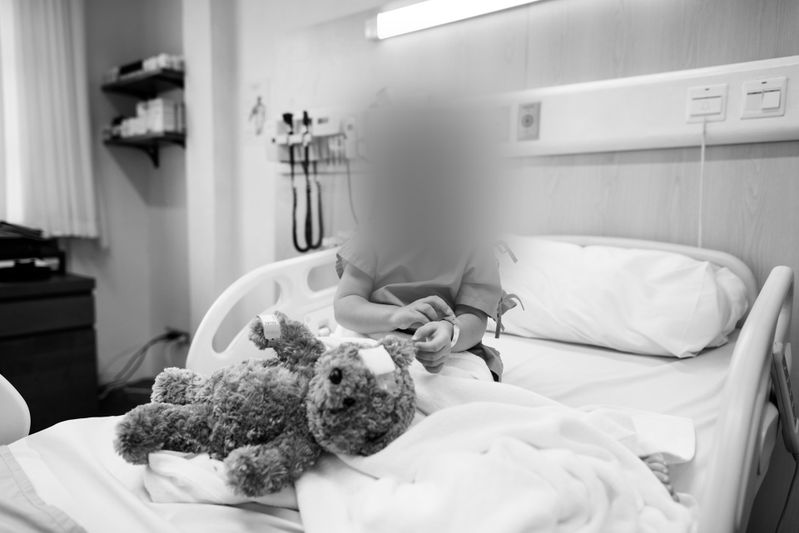
A child with a blurred face sits on a hospital bed, holding an object, with a stuffed animal beside them. The room is equipped with medical devices.

Publishing photos and videos for marketing, PR, and public communications

Marketing teams in pediatric care should not treat redaction as an afterthought. A hospital success story, donor campaign, therapy program video, or community outreach post can disclose that a child received care. Even if a family supports the story, the organization should confirm that the image release, HIPAA authorization where needed, platform use, and future reuse are aligned.

For public communications, redaction should be considered even when consent or authorization exists. A blurred sibling, visitor, patient in the background, name badge, or chart can prevent a secondary disclosure that was never intended. Consent from one family does not cover every child visible in a waiting room, group session, event, or school-based clinic video.

Organizations often use a higher threshold for youth therapy footage. Session recordings can show emotional distress, family conflict, trauma history, behavioral patterns, and other sensitive context. In many cases, the business practice is to avoid public use entirely. If footage must be shared with counsel, a payer, a regulator, or a family, redaction and access controls should be planned together.

On-premise deployment for children’s hospitals and behavioral health networks

Large pediatric providers often prefer on-premise software for redaction because source videos may include PHI, minors’ images, behavioral health content, and incident evidence. Keeping files within the organization’s controlled environment can reduce vendor transfer questions, although the overall compliance result remains context-dependent.

For enterprise deployment, integration with internal storage, access control, retention schedules, and review queues should be assessed before rollout. Children’s hospitals, youth therapy groups, and public sector health programs with specific security or compliance requirements can get in touch to discuss an on-premise setup and workflow design.

Key takeaways for pediatric visual data anonymization

Photos and videos of minors in health care settings are rarely neutral images. They can reveal identity, care location, health status, family situation, therapy participation, and sensitive incidents. HIPAA, COPPA, and state law can overlap, but the operational control is concrete: assess and redact as needed before sharing, and review the whole frame, not only the patient’s face.

Automated face blurring and license plate blurring are useful first steps. They are not a complete pediatric privacy review. Logos, tattoos, name tags, documents, wristbands, charts, and screen content require manual attention. For minors, that manual step is not a cosmetic safeguard. It is often the difference between a controlled disclosure and an avoidable privacy incident.

Neon signs against a black background depicting the word "yeah," a question mark, and a lightning bolt.

FAQ: Pediatric Visual Data Anonymization (HIPAA, COPPA, and State Law)

Does HIPAA require blurring every child’s face in a hospital video?

HIPAA does not use a simple “blur every face” formula. However, full-face photographic images and comparable images are identifiers under the HIPAA Safe Harbor de-identification method [2]. As a common compliance approach, pediatric providers often blur minor patients and bystanders before external sharing unless a valid authorization or another permitted basis applies.

Does COPPA apply to pediatric clinic videos?

Sometimes. COPPA is relevant when a covered online service is directed to children under 13 or has actual knowledge that it collects personal information from children under 13 [3]. The COPPA Rule includes photos, videos, and audio files containing a child’s image or voice in the definition of personal information [4]. Offline clinical video is usually analyzed first under HIPAA and state law, but online collection from children or child-directed upload and sharing features may trigger COPPA review.

Can automated software redact all identifying details in pediatric footage?

No. Gallio PRO automatically detects faces and license plates only. It does not automatically detect logos, tattoos, name tags, wristbands, paper documents, charts, or monitor content. Those elements should be handled in the manual editor after automated face blurring and license plate blurring.

Should therapy session recordings be used for marketing if the family agrees?

This is highly context-dependent. Youth therapy footage can expose emotional distress, family relationships, diagnoses, trauma-related content, and other sensitive information. Even with family cooperation, organizations commonly require a separate privacy, clinical, legal, and ethical review before any public use.

Is blurring needed before sending incident footage to counsel or an insurer?

Often, yes. Counsel and insurers may have a legitimate need to see relevant footage, but that does not mean every visible child, family member, staff badge, chart, or screen should remain identifiable. A limited, purpose-based redaction process is a common compliance practice.

Does on-premise software remove the need for HIPAA or state law review?

No. On-premise software can help keep files in a controlled environment, but it does not decide whether a disclosure is permitted. HIPAA, COPPA where applicable, state law, institutional policy, and the purpose of sharing still need review.

References list

  1. Health Insurance Portability and Accountability Act Privacy Rule, 45 CFR Parts 160 and 164, U.S. Department of Health and Human Services.
  2. U.S. Department of Health and Human Services, “Guidance Regarding Methods for De-identification of Protected Health Information in Accordance with the HIPAA Privacy Rule.”
  3. Children’s Online Privacy Protection Act of 1998, 15 U.S.C. §§ 6501-6506.
  4. Children’s Online Privacy Protection Rule, 16 CFR Part 312, including 16 CFR § 312.2 definition of “personal information.”
  5. Federal Trade Commission, “Complying with COPPA: Frequently Asked Questions.”
  6. 42 CFR Part 2, Confidentiality of Substance Use Disorder Patient Records, where applicable to qualifying programs and records.